In the diverse and complex world of logistics, companies offer a range of transportation and logistics services to meet their specific needs. These services range from first-party logistics (1PL) to fifth-party logistics (5PL), each with its own unique characteristics and applications.
In this article, we will review each of these types in detail, starting with 1PL, which is limited to companies that manage their entire supply chain internally, and ending with 5PL, which includes advanced solutions for managing global supply chains. We will explain the differences between these types and how to choose the most suitable solution based on company needs.
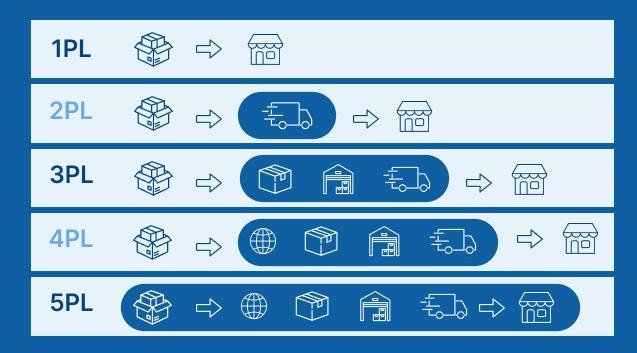
First-party logistics (1PL)
First-party logistics (FPL) is a simple transportation method where a company or factory produces and ships the product from one point to another. In this case, no part of the supply chain is outsourced; the company handles all aspects of logistics management internally, including production, transportation, and returns.
This is where an individual or company stores and transports their own goods to the end user. One-Person Lay-Off (1PL) is primarily used by small manufacturing companies that handle local distribution. These companies are therefore completely self-sufficient in their logistics.
Second-party logistics (2PL)
A second-party logistics (2PL) provider helps businesses by offering transportation solutions. Using means of transport such as trucks, ships, and airplanes, 2PL providers move and deliver inventory for multiple companies. 2PL providers do not manufacture goods; their role is limited to shipping them from one point to another.
Third-party logistics (3PL)
Third-Party Logistics (3PL) This occurs when companies rely on third parties to provide distribution, storage, and fulfillment services. 3PL companies offer integrated services encompassing fulfillment, storage, and transportation, and can be customized to meet diverse customer needs.
These services have been common in large organizations for years; however, their use is increasing, especially with companies like Alibaba and Amazon, which offer direct marketing channels for small and medium-sized enterprises (SMEs). For these companies, the cost of running fulfillment, warehousing, and distribution services is typically higher than using specialized 3PL providers, who can offer flexible services tailored to the specific needs of businesses.
Fourth-party logistics (4PL)
A Fourth-Party Logistics Provider (4PL), also known as a Lead Logistics Provider, is an independent entity that manages a client's supply chain by coordinating its own resources and technologies, along with the services of Third-Party Logistics Providers (3PLs), to deliver the best possible solutions. While there are some similarities between 4PLs and 3PLs, a 4PL takes on a vital strategic role in helping a client achieve its organizational goals and assumes full responsibility for the entire supply chain.
4PL's tasks include analyzing massive amounts of data, managing transportation and storage operations, organizing third-party suppliers, as well as performing many other tasks aimed at improving supply chain efficiency.
A key characteristic of a fourth-party logistics provider (4PL) is its neutrality. While a 4PL may offer the services a client needs, it must compare those services and costs with its competitors to ensure the best possible decision is always made in the client's best interest.
Fifth-party logistics (5PL)
5PL is a significant advancement in logistics, combining 3PL services with the optimization of 4PL supply chains. These services offer the most sophisticated logistics solutions, managing multiple global supply chains. Through these services, companies can entrust 100% of their logistics and supply chain management to 5PL.
5PLs are organizations that optimize every process to improve overall logistics. They control all operations, from manufacturing to reverse logistics. However, for many medium-sized tasks, contracting with 3PL and 4PL operators may be necessary to perform certain services.
Advantages and disadvantages of 1PL, 2PL, 3PL, 4PL, and 5PL logistics service models
| Model | Advantages | Disadvantages |
|---|---|---|
| 1PL | • Complete control over logistics operations • Flexibility in managing operations • Direct communication with customers | • High costs of maintaining logistics infrastructure • Difficulty scaling up as the business grows • Requires significant investment in resources and expertise |
| 2PL | • Access to specialized expertise in the transportation sector
• Cost-effective for companies with in-house execution services • Frees up internal resources | • Limited scope focused solely on transportation • No comprehensive logistics solutions • Reliance on external transportation companies |
| 3PL | • Easily scalable on demand • Specialized logistics management expertise available • Cost savings thanks to economies of scale | • Initial costs may be high compared to internal management. • Reduced control over processes. • Reliance on a third party may lead to reliability issues. |
| 4PL | • Comprehensive supply chain management • Streamlined operations and increased efficiency • Cost reduction through improved logistics • A single point of contact for all supply chain needs | • Higher costs compared to third-party services • Over-reliance on a single provider • Complexity in managing relationships with service providers |
| 5PL | • Optimize the entire supply chain network • Integrated solutions and innovative processes management • Provide complete control and transparency in operations | • Higher costs due to customized and comprehensive services • May require more time to analyze data and integrate different systems • Reliance on advanced technologies may require a significant investment of time and resources |
The difference between 1PL, 2PL, 3PL, 4PL and 5PL in logistics in a table with an illustrative example:
| Model | Description | the role | Example |
|---|---|---|---|
| 1PL | Logistics provided by the owner | The company manages all logistics operations itself, without any external party, making it suitable for companies that prefer to maintain direct control over their logistics operations and have the necessary resources to do so. | The factory owner transports the manufactured products directly from the factory to the store. |
| 2PL | Logistics services through an external provider | Involving a second party such as transport companies or airlines to transport goods. | A shipping company that transports manufactured products from the factory to the store. |
| 3PL | Logistics services through an external service provider | A logistics company that manages transportation and logistics services between the producer and the distributor. | A logistics company that transports manufactured products from the factory to the store and manages storage and loading. |
| 4PL | Logistics services through an external consulting provider | A logistics company that manages several 3PL companies and acts as a strategic supply chain consultant. | 4PL operates several 3PL companies to organize the transportation and storage of manufactured products from the factory to the store. |
| 5PL | Integrated logistics services | A logistics company that manages and improves the entire supply chain network, selecting the best alternatives. | 5PL manages and optimizes all aspects of the supply chain to move manufactured products from the factory to the store in the best possible way. |
What should be taken into consideration when implementing a PL supply chain?
When seeking supply chain solutions, it is essential for a company to assess the most suitable level of logistics services based on its needs. Key factors to consider include:
- cost:
1 At level 1PL (first-party logistics), there is no external provider, which means there are no additional costs other than those borne by the company itself.
2 In 2PL (second-party logistics), the cost is usually limited to transportation costs only.
3 As we progress to 3PL, 4PL and 5PL levels, costs increase significantly due to logistics providers offering additional integrated services.
4 At the 5PL level, the higher cost is a result of providing comprehensive solutions, but it comes with the advantage of full supply chain coordination. - Company needs:
Is it a small or large company?
Does it require international shipping?
How complex is its supply chain?
It is essential to avoid choosing logistics services that are overly sophisticated for the company's needs. For example:
Small businesses with a simple supply chain may find 4PL or 5PL services more complex than they need. Conversely, 1PL or 2PL services may suffice for businesses that don't require complex logistics support. If a company ships locally and has the capacity to store products internally, it may be best to handle the operations in-house.
Examples of how to choose the most suitable logistics model for you?
The needs of different industries vary in choosing the logistics model that best suits them. For example:
- 1PL: Small businesses or local retailers who handle shipping and delivery operations internally.
- 2PL: Companies that rely on specialized transportation services such as road or sea freight.
- 3PL: E-commerce businesses that need product storage and distribution management services.
- 4PL: Large companies that require fully integrated supply chain management.
FAQ:
- What is 1PL? 1PL means that the company manages its own logistics operations without intermediaries.
- What is the difference between 1PL and 2PL? 2PL relies on an external end for transmission, while 1PL manages the processes internally.
- What are the benefits of 3PL? 3PL offers comprehensive services such as transportation andstorageThis reduces costs and increases efficiency.
- When should you use 4PL? Use it when you need integrated supply chain management.
- How do you choose between models? Based on the scope of work, budget, and required level of control.
- Is switching from 3PL to 4PL expensive? It may be costly initially, but it offers long-term savings.
Conclusion:
Understanding the advantages and disadvantages of different logistics models such as 1PL, 2PL, 3PL, 4PL, and 5PL is crucial for optimizing supply chain management. Each model offers varying levels of control, cost, and experience, necessitating a choice. The most suitable logistics partner Based on the company's needs, the right choice can improve workflow, achieve cost savings, and enhance customer service, thus boosting market competitiveness.