A customs tariff is a tax or duty levied on goods exported to or imported into a particular country. Tariffs are most often imposed on imports, with the aim of protecting domestic products from foreign competition. They give domestically manufactured products a competitive advantage by making them more price-competitive compared to foreign products. Furthermore, customs tariffs are an important source of government revenue.
Export tariffs are less common than import tariffs, but they do exist in some cases. These tariffs are applied to domestic goods sold abroad.
What is a customs tariff?
A customs tariff is a tax or duty levied on imported goods when they enter a country's borders. These duties are a means for governments to protect their domestic industries from foreign competition, as well as to generate revenue for the public treasury. The value of the customs tariff varies depending on the type of imported product and the country of origin.
Objectives and benefits of customs tariffs:
- Increased revenue: Governments impose tariffs with the aim of increasing tax revenue.
- Protecting domestic industries: Tariffs are used to protect domestic industries from foreign competition, which promotes the growth of national sectors.
- Encouraging local industry: By raising the cost of some imported products compared to local products, customs tariffs encourage support for national industry.
- Protecting local employment: Tariffs are an effective tool to support and protect local employment opportunities by reducing reliance on imported goods.
- A means of political pressure: Some countries use tariffs as a means of exerting pressure on other countries, by increasing fees on basic products, to force them to comply with economic or political demands.
The impact of tariffs on international trade:
When a country imposes tariffs on imported goods, it increases the cost of those goods, which can affect consumers' purchasing power. This can also negatively impact the economic opportunities of exporting companies and reduce the volume of trade between countries.
If you plan to export your goods to other countries, it's important to consider tariffs when setting product prices. For example, you can adopt a pricing strategy that involves reducing the profit margin on each product to offer competitive prices that align with local prices in the importing country. You can also reduce costs in production or transportation to minimize the impact of tariffs on the final product price.
Advantages and disadvantages of customs tariffs
Advantages:
- Increased government revenue: Customs duties help the government collect additional money, which contributes to reducing the tax burden on citizens and helps to reduce the budget deficit.
- Opening channels of negotiation: Customs tariffs are a powerful tool for countries in trade or political negotiations, as each party can use tariffs to achieve its economic goals and influence its trading partners.
- Supporting local industries: Customs duties are commonly used to ensure that local products gain a stronger foothold in the markets, thus supporting local businesses and the national economy in general.
- Promoting market stability: Tariffs can help make the market more stable and provide predictable prices, which contributes to improving the business climate.
Disadvantages:
- Stirring up tensions between countries: Many countries use tariffs as a means of putting pressure on other countries over certain issues, which can cause political tensions and exacerbate disputes.
- Escalating trade wars: Imposing tariffs often leads to similar reactions from other countries, causing a trade war that benefits none of the parties involved, and instead leads to a deterioration in trade and economic relations between countries.
Saudi Customs Tariff Code:
In Saudi Arabia, the HS code is known as the Saudi Tariff Code . Saudi tariff codes consist of 12 digits and are regulated by the General Authority of Zakat and Income Tax and Customs . The first six digits of the Saudi tariff code follow the same HS code adopted by the World Customs Organization (WCO), while the next two digits are adopted from the unified tariff system of the Gulf Cooperation Council (GCC) countries , and the last four digits are specific to Saudi Arabia .
To find the Saudi tariff codes for exported products, the official Saudi Customs search engine can be used.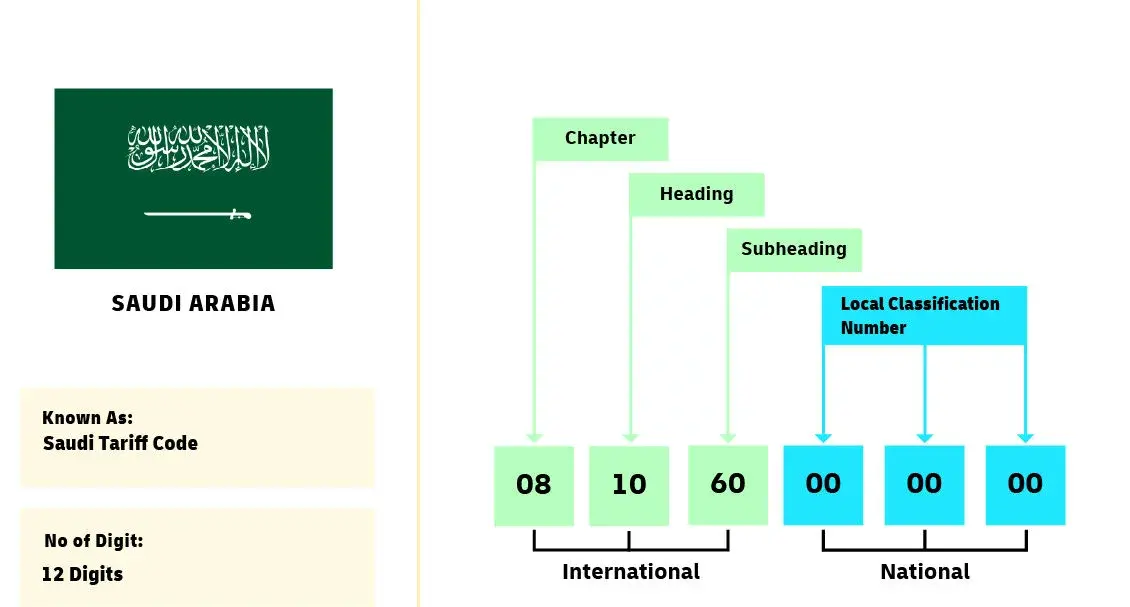
HS (Harmonized System) code:
The HS code is an international classification system used to identify and classify goods and products in international trade. This system was developed by the World Customs Organization (WCO).It consists of six columns representing essential information about the nature of the goods, such as their type, composition, and use. This system is based on a standardized classification of goods in more than 200 countries worldwide and forms the basis for many customs regulations.
For example, if you have a particular product, you can find out which HS code that this product belongs to based on its specifications.
The main difference between an HS code and a customs tariff code:
- The HS code is an internationally recognized classification, while the customs tariff code may vary from country to country according to each country's national system.
- The HS code is used to classify products in general in international trade, while the tariff code is used to determine customs duties on imported products.
Conclusion:
Customs tariffs are an important tool in regulating trade between countries, playing a role in protecting domestic industries from foreign competition and generating government revenue. While they benefit the local economy, tariffs can also lead to higher prices for consumers and negatively impact their purchasing power. Therefore, it is essential that these tariffs be balanced and carefully considered to maximize economic benefits while safeguarding the interests of citizens.