The shipping industry is experiencing remarkable growth as more and more people order products online, resulting in them being delivered directly to their homes.
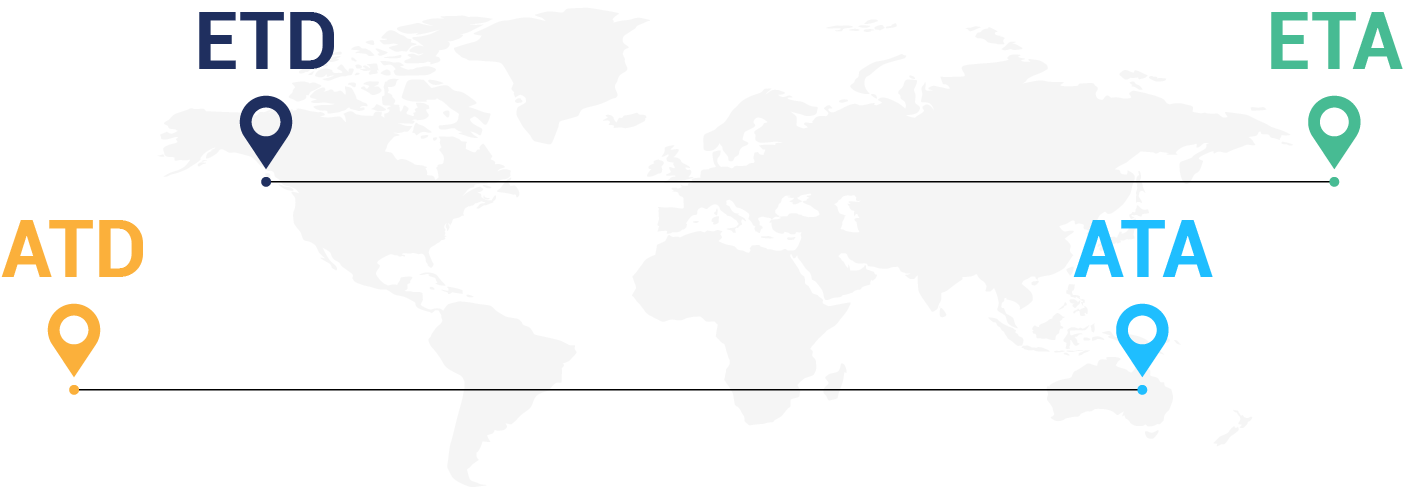
"When will my order arrive?" is a common question many people ask when ordering something. But to get an accurate answer, it is necessary to use more specific logistical terms such as ETD (Expected Time to Leave), ETA (Expected Time to Arrive), ATA (Actual Time to Arrive), and ATD (Actual Time to Leave).
Using these terms helps you organize, track, and prioritize deliveries more effectively, enabling you to provide customers with clear and specific answers regarding shipment arrival times. This article will explore the differences between these terms and how to use them correctly in a logistical context.
What is ETA?
ETA stands for Estimated Time of Arrival. This term is used as a time indicator to specify the expected time of arrival of a vehicle at its destination. With the advent of new tools Digital planning
Companies are now able to determine estimated delivery times more accurately. This information allows you to inform your customers of when deliveries will arrive and
What is ETD?
ETD stands for Estimated Time of Departure . This term is used as a time indicator for the expected time a vehicle will leave its point of origin. It refers to the moment when transportation or cargo actually begins moving from its original location toward its destination. ETD is determined based on transportation schedules, traffic, and other logistical factors that may affect the departure process.
What is ATD?
ATD stands for "Actual Time of Departure," meaning "the actual time of departure - the actual departure date." It refers to the actual date and time a ship leaves port. ATD is based on the actual departure time and may be affected by several factors such as weather conditions, vessel availability, and cargo volume in port.
ATD is important for both shippers and recipients because it helps determine delivery times more accurately. Any delay or change in ATD can affect delivery dates and may result in additional
What isATA ?
ATA stands for Actual Time of Arrival . This term refers to the time a vehicle or shipment actually arrives at its final port or terminal, whether it's a ship, plane, or truck. ATA is used to compare the actual time with the ETA (Estimated Time of Arrival) to determine if the shipment arrived on time or was delayed, helping to track arrival times and provide accurate responses to customers.
Uses of ETA, ETD, ATD, and ATA in logistics:
- Estimated Time of Arrival (ETA): ETA is used in international trade contracts to ensure both parties have clear expectations about when goods will arrive. This helps organize logistical operations, such as preparing equipment or determining pickup locations, thus improving the customer experience.
- Estimated Time of Departure (ETD): ETD is used in shipping documents and commercial contracts to specify when goods will leave the country. It helps confirm the transport plan and facilitates coordination between carriers and other relevant parties, contributing to better operational efficiency.
- Actual Departure Time (ATD) and Actual Arrival Time (ATA): In the transportation and logistics industry, ATD and ATA are crucial indicators for measuring the deviation of actual transit time from the expected time. Using these indicators helps assess the efficiency of transportation operations and identify inefficiencies. By comparing ATD and ATA with ETD and ETA , transportation plans can be continuously adjusted, cost control processes improved, and on-time service delivery ensured.
The difference between ETA and ETD and an explanation of the difference between them:
| Concept | ETA (Estimated Time of Arrival) | ETD (Estimated Time of Departure) |
|---|---|---|
| Definition | The estimated time in which an item, vehicle, or person is expected to arrive at a particular destination. | The estimated time at which an element or vehicle is expected to leave the point of origin. |
| the focus | It relates to the topic reaching its destination. | It involves leaving the topic from the starting point. |
| Main users | Customers, passengers, recipients, tracking services. | Transportation companies, logistics providers, travel organizers. |
| Importance | It helps in determining when parcels will arrive, planes will land, or people will arrive. | It helps in determining the departure time of flights, ships, or shipments. |
| Impact on the customer | It provides accurate arrival times, which enhances the customer experience and helps in planning. | It helps in planning logistical operations and enhances the customer experience by providing accurate information. |
| Practical field | Improving the end of the journey or delivery of goods. | Improving the start of the journey or the on-time departure of the shipment. |
| Common uses | Shipment tracking, travel information, parcel arrival tracking. | Travel organization, shipment management, determining port departure times. |
| Examples of use | Knowing when the parcel will be delivered, the plane will land, or the person will arrive. | Knowing when the journey will begin, the ship will leave the port, or the truck will start its journey. |
| Importance of information to users | Reduce uncertainty and enhance planning and forecast management. | Managing logistics operations efficiently and ensuring timely service delivery. |
| Importance in planning | Important for improving the end of the journey, such as scheduling staff or resources to arrive. | Important for managing the start of the journey, and ensuring that vehicles or shipments leave on time. |
How to calculate ETA and ETD
To calculate the estimated departure time (ETD) and estimated arrival time (ETA), you can follow these steps:
- General formula:
Expected time = (distance ÷ speed) + additional delays - Estimate the distance Calculate the distance between the starting point and the destination using a map or route planning tools.
- Speed check Use the average speed of the vehicle (e.g., 60 km/h for a truck or 740 km/h for an airplane).
- Consider intermediate stops Add the time of stops such as rest or checks to your account.
- Weather conditions Add time lost due to bad weather.
- Refueling Add the time required to refuel.
- Traffic Add delay time due to traffic congestion.
Example:
A truck that travels 600 kilometers at a speed of 60 km/h:
- Travel time = 600 ÷ 60 = 10 hours
- Delays: 1 hour rest period + 20 minutes for refueling + 2 hours of traffic = 3 hours and 20 minutes
- Estimated arrival time = 10 hours + 3 hours and 20 minutes = 13 hours and 20 minutes
If the truck leaves on May 30 at 10:00 AM, the expected time of arrival will be 11:20 PM on the same day.
The relationship between ATD, ETD, ETA, and ATA
- Comparison between ATD and ETD: This comparison helps in assessing the extent of adherence to deadlines during the initial stages of the shipping process.
- ATD: This is considered the starting point for calculating the actual transit time, and through ATA (Actual Time to Arrival), the actual transit time can be determined.
- Any change in ATD may necessitate an adjustment to ETA (Estimated Time of Arrival), directly affecting the entire shipping plan.
Monitoring logistics companies: ATD is closely tracked, and if ATD frequently falls behind ETD, this may indicate a need to improve loading processes or adjust initial planning. ATD is used to improve overall service quality and increase the accuracy of time forecasts.
How can familiarity with ETA, ETD, ATD, and ATA help you?
Logistics events are essential in facilitating the shipping process. Depending on their role in logistics activities, these events can help you:
1. Shipping agent:
These events help determine the best shipping route and minimize delays. By knowing arrival and departure times, the agent can better plan the next steps in the shipping process, increasing efficiency and reducing costs.
2. Port operators:
Logistical events help port operators improve cargo flow and reduce delays. By accurately tracking arrival and departure times, vessel handling can be optimized and time spent in ports reduced.
3. The supplier:
Understanding these events helps you plan shipments more efficiently. Knowing when a ship will be ready or arrive allows you to avoid unnecessary storage and transportation costs, thus improving operations and reducing expenses.
4. The recipient:
Knowing the arrival dates of shipments makes it easier to track goods and prepare the necessary equipment for receiving them. This helps you optimize your delivery schedule, anticipate potential delays, and avoid additional costs resulting from delays.
5. Customs brokers:
These events contribute to expediting customs procedures. By knowing the exact arrival and departure times, it is possible For customs brokers Preparing the necessary documents and organizing the customs clearance process on time, which facilitates the shipping process in general.
General benefits of accurate time prediction
Precise forecasting of arrival times and expected arrival times could revolutionize the shipping industry, as this high level of accuracy can only be achieved through the use of advanced artificial intelligence algorithms. If ports and shipping companies worldwide adopt these algorithms,
Ship tracking system Predicting arrival times will lead to numerous benefits, including but not limited to:
- Goods and services arrive on time.
- Improving the supply chain.
- Reducing congestion in ports.
- Improving shipping methods.
- Reduce fuel consumption.
- Improving environmental impact.
Why should you know international trade terminology?
Accurately understanding and using terms such as ETA, ETD, ATA, and ATD is crucial for logistics operations and has a significant impact on several key aspects of the supply chain, including:
Improving operational efficiency
through a thorough understanding of Estimated Time to Date (ETA/ETD) and Actual Time to Date (ATA/ATD) allows logistics companies to effectively manage their human and material resources. This helps avoid waste caused by inefficient resource utilization or the need for emergency shipments. Furthermore, providing accurate information enhances communication between different parties, contributing to more efficient logistics operations.
By monitoring the accuracy of ETA and ETD data, companies can mitigate the risk of delays, anticipate potential delays, and take necessary actions to minimize their impact on other operations. ATA and ATD data also help identify the root causes of problems, enabling continuous process improvement and achieving optimal delivery times.
Improving customer service
in today's shipping world means customers expect their goods to be delivered on time. By precisely controlling ATA (Accounting Time Data), logistics companies can provide customers with quick and accurate shipment arrival times, allowing them to plan more effectively. Analyzing ATA and ATD (Accounting Time Data) data also helps to continuously reduce transit times, further enhancing the level of service provided to customers.
In conclusion:
By using standards such as ETA, ETD, ATD, and ATA in logistics operations, coordination among various stakeholders can be enhanced, and planning and scheduling can be improved. These standards help reduce costs and improve efficiency and effectiveness in the supply chain by tracking operations and providing accurate reports on actual performance. Ultimately, these tools contribute to ensuring on-time delivery of goods, which enhances customer satisfaction and increases the overall effectiveness of logistics operations.