As an exporter, it is essential to be familiar with the various payment methods available in the international market. Choosing the right payment method can significantly impact your financial risks and the success of your export business.
Payment methods are a key factor influencing the success of an export transaction. Based on these methods, the exporter and importer decide whether to proceed with the export deal. Each party seeks to protect its interests to the fullest extent; the exporter prefers to receive full payment before the shipment leaves their warehouse, while the importer prefers to pay only upon delivery of the shipment to their warehouse.
If each party sticks to its position, this situation could lead to the failure of negotiations and the cancellation of the entire export process.
What options are available in the export process? Are there other payment methods that can ensure trade protection for both parties?
We will review the various payment options available to exporters, and you will have a clearer view of the available payment options and how to make informed decisions about the most suitable method for your business.
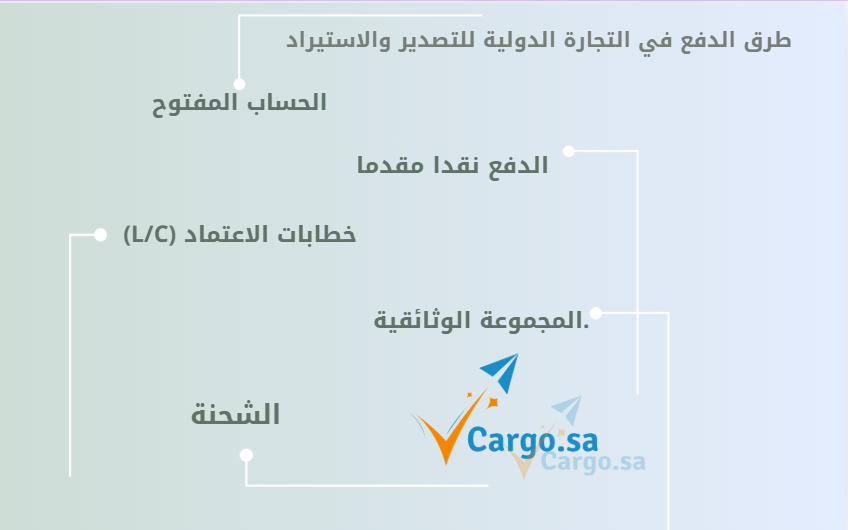
The most important payment methods in international trade for export and import:
1-Open Account
1-Open Account
This method is based primarily on the principles of credit, whereby the importer is obligated to pay the amount due upon receipt of the goods. A specific credit period is agreed upon between the exporter and the importer, and the importer must make the payment within this period. This period can range from 30 to 90 days, or as otherwise agreed upon by both parties.
Open account payment is an attractive option for importers, but it poses a greater risk for exporters, as the likelihood of bad debts or fraud increases when this method is adopted.
It is also one of the most common payment methods in international trade. It is suitable when the importer is allowed to defer payment until the goods are received, inspected for quality, used, sold, or distributed.
If you are an exporter, it is essential to choose your credit period carefully. Long periods can negatively impact an exporter's working capital, potentially hindering their ability to provide optimal service. Furthermore, an exporter may face significant challenges during the manufacturing and shipping phases if the credit period is extended.
Payment methods:
In an open payment account, transactions are conducted directly between the two parties without the need for bank intervention, allowing for invoice settlement through various means such as:
- Credit or debit cards.
- Pay online.
- Wired bank transfer.
Suitable for:
This method is ideal in cases where there is a long-term relationship between the exporter and the importer, giving the exporter confidence in receiving payment on time.
2. Cash-in-Advance Payment
Cash payment in advance is considered the most reliable method of international payment for exporters, and it is also one of the easiest payment methods for both parties. In this method, the importer pays the full amount before the exporter ships the goods.
The benefit for the exporter is the absence of non-payment risk, in addition to receiving the full amount upfront. For the importer, however, this method means negative cash flow, with the risk of not receiving the goods or receiving defective goods.
Payment methods:
In the context of international trade, cash payments are not actually made upfront. Instead, importers pay using:
- Letter of credit
- Bank transfer (wire transfer)
- Online payment through the payment gateway
- Credit card payments
- Debit card payments
- Prepaid debit card
- International check
3. Letters of Credit (L/C)
Letters of credit Letters of credit, also known as documentary credits, are legally binding financial instruments issued by banks or specialized trade finance institutions.
It is the most common method used by the majority of international merchants to pay, and it is also one of the safest ways to make international payments.
A letter of credit requires an importer and an exporter, with an issuing bank and a confirming bank or advisory bank, respectively. In this type of trade finance, the financial solvency and creditworthiness of the lenders are crucial. The issuing bank and the confirming bank effectively replace the buyer's guarantee of payment, thus reducing the risk for the supplier.
The issuing bank and the confirming bank work to replace the buyer's payment guarantee, reducing the risks to which the supplier may be exposed.
This process is known as credit enhancement.
payment method :
Documentary credits are generally processed according to the following steps:
- The importer agrees with the exporter to purchase the goods and a purchase order is issued.
- The importer goes to the issuing bank to obtain the letter of credit.
- The source deals with the confirmed bank to check the documents.
- When the conditions are met, the supplier ships the goods.
- After examining the documents, the confirming bank sends the documents to the issuing bank.
- Payment is made according to the agreed terms, and the issuing bank releases the documents so that the importer can receive the goods.
- Ultimately, the funds are transferred between banks to the source.
4. Documentary Collections
Documentary collection, also known as a bill of exchange, is the most balanced method of international payment in terms of the risks to both the seller and the buyer. In this method, the seller does not receive payment before the shipment is sent, but the buyer cannot take possession of the shipment until the full amount is paid ("Documents against Payment") or a firm commitment is made to pay by a specific date ("Documents against Acceptance").
In the document collection method , the seller ships the goods and delivers the shipping documents (including the bill of lading indicating the condition of the goods) to their bank. The seller's bank then issues a payment order to the buyer's bank, which requests payment from the buyer. When payment is received in full (or the buyer agrees to pay on time in the case of a debit/credit agreement), the seller's bank forwards the shipping documents to the buyer's bank, which then forwards them to the buyer so they can take possession of the shipment.
Main types:
- Cash against documents (CAD/DP): In this case, the importer is responsible for paying the money after receiving the shipping documents, with the importer’s bank paying the amount after verifying the documents.
- Document Against Acceptance (DA): In this case, the buyer is only required to pay the amount after accepting the trade agreement. Once the buyer accepts the trade and confirms the terms, the bank then issues draft documents to the issuer.
How to pay:
- The exporter and importer agree to use documentary collections.
- The exporter prepares a payment voucher and sends it via his bank to the importer's bank.
- The bill of exchange provides payment instructions and required documents.
- The importer's bank releases the documents after:
- Full payment received.
- Or obtain the importer's approval for future payment.
- The importer uses the documents to clear the goods from customs.
- The importer's bank sends payments to the exporter's account.
There is a difference between a letter of credit and documentary collections, where in a letter of credit the bank guarantees payment to the exporter, while in documentary collections the bank’s role is limited to facilitating the transfer of documents without guaranteeing payment.
5. Shipment - Consignment
Payment by shipment is very similar to an open account. Importers have a long period of time to make the final payment. Generally, exporters using this method do not deal with an established company or a large importer, but rather primarily with a few local distributors.
In this case, the supplier receives payment when the distributor sells the goods to customers and earns money from those sales. Those interested in this method should rely only on trustworthy distributors.
Risks:
- Source: This option is considered the highest risk for the source, as they only receive their money after the goods are sold.
- Importer: This is considered the least risky option for the importer, as he obtains the goods quickly and does not have to pay the amount until he sells them.
How to pay:
Shipping costs can be paid for using any of the following payment methods:
- Credit card
- Pay online
- Bank transfer
- The check
Suitable for:
This method is used when there is a good relationship between the buyer and seller and the goods are in pre-order or likely to sell. The success of this method depends on the distributor, so it is essential that exporters choose their distributors carefully.
Factors influencing the choice of payment method for export transactions
- Transaction size: Large transactions may require more secure payment options such as letters of credit, while small transactions can be more flexible.
- Buyer's creditworthiness: If the buyer has a strong credit rating, opening a bank account may be a suitable option. However, if the buyer is not considered trustworthy, prepayments or a letter of credit may be more appropriate.
- Costs and risks: The seller must consider the costs associated with each payment method and the risks associated with non-payment.
- Transaction type: Some transactions may require a secure payment such as documentary collections or prepayment, while an open account may be appropriate for long-term business relationships.
- Flexibility for the buyer: For larger buyers or those with lower creditworthiness, methods such as prepayment or letters of credit may be more practical.
- The country's banking system: In some countries with a weak banking system or that are subject to international sanctions, caution should be exercised when dealing with them.
- Commercial regulations: Regulations vary from country to country and should be taken into account when choosing a payment method.
Comparison of different payment methods in exporting: advantages and disadvantages for importers and exporters
A table comparing five major payment methods in international trade, outlining the advantages and disadvantages for both exporters and importers to help them choose the most suitable method based on their needs and transaction circumstances.
| method | Advantages for the importer | Disadvantages for the importer | Features of the source | Disadvantages of the source | Best suited to the party |
|---|---|---|---|---|---|
| Payment in advance | Money-back guarantee before shipping. | This may lead to a strain on cash flow. | Financial security, guarantee of receiving the payment in advance. | Buyers may refuse due to strict payment terms. | Source: Offers financial security. Importer: May be rejected by some buyers. |
| Letter of credit | Guaranteeing receipt of goods after fulfilling the conditions. | High costs and bank fees. | High financial security, guaranteed payment from the bank. | Additional bank fees, complicated procedures. | Source and importer: Good for parties who do not know each other well. |
| Open account | Flexible payment options after receiving the goods. | He may have difficulty paying the amount if sales are lower. | Building long-term business relationships. | Additional bank fees, complicated procedures. | Importer: If they have liquidity. Exporter: In cases of high trust. |
| Documentary collection | Protection against non-receipt of goods. | Payment delay due to document transfer. | Ensuring receipt of documents before shipping goods. | You may have difficulty receiving payments if there are problems with the documents. | Importer and exporter: In the case of dealing with unknown parties. |
| Shipment | Payment is only made after the goods have been sold. | The buyer may bear the risk of non-sale. | Entering new markets without the need to store inventory. | Payment is confirmed upon sale of goods. | Importer: If they have good marketing capabilities. Exporter: If they are willing to take risks. |
The most suitable option for both parties:
- Source: If he is looking for quick financial security, prepayment or a letter of credit are the best options.
- Importer: If he has good liquidity and wants payment flexibility, an open account is the most suitable option.
- Both parties: If dealing with an unknown party, a letter of credit or documentary collection is considered the safest option.
Conclusion:
Choosing the right payment method for export transactions is crucial to ensuring secure and efficient payments. Companies must understand the different payment methods and assess the associated risks and costs. By collaborating with buyers and banks and taking appropriate measures, delays or payment problems can be avoided. A suitable payment method fosters trust between the parties and contributes to the success of international trade transactions.