What are Incoterms?
(Incoterms) It is a set of international rules that define the responsibilities of the buyer and seller in international sales contracts. (ICC) To facilitate global trade and clarify the obligations of the parties involved in the transport of goods.
Meaning of the term Incoterms
The term "Incoterms" is an abbreviation for "International Commercial Terms," which means "international trade terms." These terms are used to define and clarify the responsibilities and costs related to the shipping and delivery of goods between contracting parties.
Benefits of Incoterms
- Clarification of obligations: It helps to clearly define the responsibilities and costs associated with shipping, insurance, and customs clearance.
- Risk reduction: It reduces the risks arising from misunderstandings or disputes between parties.
- Harmonization of business practices: It contributes to the standardization of international trade rules, facilitating cross-border trade.
Governments' views on Incoterms
Governments usually support the use of Incoterms because it provides a standard framework that helps facilitate international trade and reduces legal disputes related to shipping and delivery.
Incoterms
- EXW - Ex Works (Receipt of goods from the factory floor)
- FOB - Free On Board (Delivery on Board)
- FAS - Free Alongside Ship (Delivery next to the ship)
- CFR - Cost and Freight
- CIF - Cost, Insurance, and Freight
- FCA - Free Carrier
- CPT - Carriage Paid To
- CIP - Carriage and Insurance Paid To
- DAP - Delivered At Place
- DAT - Delivered At Terminal
- DDP - Delivered Duty Paid
Incoterms rules
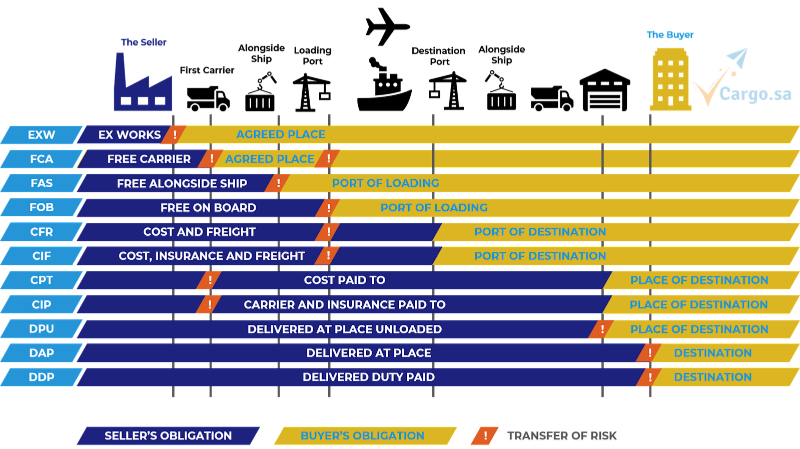
The Incoterms rules define the distribution of costs and risks between the seller and the buyer from the moment the goods are delivered until they are received. The Incoterms rules can be divided into two main categories:
1- Transportation rulesMarineInland waterways:
- FAS - Free Alongside Ship: The seller delivers the goods alongside the ship at the specified port. The buyer assumes all transportation and insurance costs from that point onward, while the seller handles customs clearance for export.
- FOB - Free on Board (Free On Board): The seller transports the goods on board the ship at the specified port. After the goods are loaded, the buyer assumes all costs and risks. This adds an extra step compared to FAS, where the seller handles loading the goods onto the ship.
- CFR - Cost and Freight: The seller pays for shipping to the port of destination, but the risk passes to the buyer when the goods are loaded onto the ship. This clause adds shipping costs to what is included in FOB.
- CIF - Cost, Insurance, and Freight: The seller bears the shipping and insurance costs up to the port of destination. The risk passes to the buyer when the goods are loaded onto the ship. This clause adds insurance to the shipping costs stated in CFR.
2- Rules for all means of transport:
- EXW (Ex Works): The seller provides the goods at their location, and the buyer assumes all costs and risks from that point. This option represents the minimum obligation for the seller and gives the buyer greater responsibility.
- FCA - Free Carrier (Delivered to Carrier): The seller delivers the goods to the carrier at a specified location. The seller is responsible for export, while the buyer assumes all costs and risks after the goods have been delivered to the carrier.
- CPT - Carriage Paid To: The seller pays for transportation to the agreed destination. The risk passes to the buyer upon delivery of the goods to the carrier.
- CIP - Carriage and Insurance Paid To: The seller covers the costs of transportation and insurance up to the agreed destination. The risk passes to the buyer upon delivery of the goods to the carrier.
- DAT - Delivered at Terminal: The seller assumes all costs and risks until the goods are unloaded at a pre-determined location. This includes export customs clearance only.
- DAP - Delivered at Place: The seller assumes all costs and risks until the goods are delivered to the specified location. This includes customs clearance for export, but not for import.
- DDP - Delivered Duty Paid: The seller assumes all costs and risks until the goods are delivered to the final destination, including customs duties and taxes. The buyer is only responsible for unloading the goods.
The purpose of Incoterms rules
The purpose of Incoterms is to regulate international trade clearly and effectively, clarifying responsibilities and costs between the seller and the buyer, thus helping to avoid disputes and ensure that contracts are executed smoothly.
Classifying Incoterms according to delivery point and distribution of responsibilities
- Group "E"
- EXW - Ex Works (Delivery at Work): The seller provides the goods at their location. The buyer assumes all costs and risks thereafter.
- Group "F"
- FCA - Free Carrier: The seller delivers the goods to a designated carrier. The buyer then bears the costs.
- FAS - Free Alongside Ship: The seller delivers the goods alongside the ship. The buyer is responsible for loading and shipping costs.
- FOB - Free on Board (Delivery on Board): The seller delivers the goods on board the ship. The buyer assumes all costs and risks from that point.
- Group "C"
- CPT - Carriage Paid To (Carriage Paid To Destination): The seller pays for transportation to the specified destination. The buyer assumes all risks thereafter.
- CIP - Carriage and Insurance Paid To: The seller pays for transportation and insurance to the specified destination. The buyer assumes the risk thereafter.
- CFR - Cost and Freight: The seller pays for shipping to the destination port. The buyer assumes the risk after the goods have been loaded.
- CIF - Cost, Insurance, and Freight: The seller pays for shipping and insurance to the destination port. The buyer assumes the risk after the goods have been loaded.
- Group "D"
- DAP - Delivered at Place: The seller bears the costs and risks up to the final destination. The buyer assumes responsibility thereafter.
- DPU - Delivered at Place Unloaded: The seller delivers the goods after they have been unloaded at the specified destination. The seller bears all costs and risks up to that point.
- DDP - Delivered Duty Paid (DDP): The seller assumes all costs and risks up to the final destination, including customs duties.
Mistakes to avoid in Incoterms
- Omission of details: Failure to specify precise details regarding the delivery location and costs.
- Misunderstanding of terminology: Using terminology in an incorrect or inconsistent way.
- Failure to update: Using older versions of Incoterms and not updating them to the latest versions.
Points not covered by Incoterms
- Determining or transferring ownership of goods: Incoterms do not specify how ownership of goods is transferred from the seller to the buyer or the ownership rights related to the goods. The issue of ownership of goods must be addressed through additional terms in the sales contract.
- Payment terms and service contracts: Incoterms does not cover details of payment terms or any provisions relating to service contracts. It also does not cover other contractual rights and obligations except those relating to the delivery of goods.
- Protection of parties against risks or losses: Incoterms does not provide protection for parties against risks or losses that may occur before or after the delivery of goods. Insurance coverage during the pre- or post-delivery period is not covered by Incoterms.
- Details of the transport and delivery of goods: While Incoterms defines cost and risk responsibilities, it does not include precise details about the transport and delivery process, such as container loading. These details must be addressed separately in the sales contract.
- Defining rules or regulations: Incoterms are not legally binding; rather, they are a set of guidelines used to clarify the obligations of the parties. There is no default Incoterm if the term is not specified in the contract; therefore, the terms must be clearly defined in the contract to avoid any ambiguity.
The table below outlines the responsibilities of the seller and buyer under each Incoterm, detailing how costs and tasks are distributed. .
| Incoterms | Seller's responsibilities | Buyer's responsibilities |
|---|---|---|
| EXW | Buyer's responsibilities | Shipping costs, insurance, and import duties from the site and beyond |
| FOB | Loading the goods onto the ship | Shipping costs, insurance, and import duties after loading |
| FAS | Delivering goods alongside the ship | Loading goods onto the ship, shipping costs, insurance, and import duties |
| CFR | Loading the goods onto the ship and paying the transportation costs | Insurance and import duties after the goods are loaded onto the ship |
| CIF | Loading the goods onto the ship and paying for transportation and insurance costs | Insurance and import duties after the goods are loaded onto the ship |
| FCA | Delivering the goods to the specified carrier | Transportation costs, insurance, and import duties from the point of delivery and beyond |
| CPT | Pay transportation costs up to the specified destination | Insurance and import duties after the point of delivery |
| CIP | Pay for transportation and insurance costs up to the specified destination. | Import duties after the point of delivery |
| DAP | Delivery of goods to the specified location | Import duties and customs clearance fees upon arrival of goods at the specified location |
| DAT | Delivery of goods to the specified station | Import duties and customs clearance fees upon arrival of goods at the designated station |
| DDP | Delivering the goods to the specified location and paying all costs and customs duties | Receive the goods at no extra cost |
conclusion
Prepare rules Incoterms A fundamental tool in international trade, providing a clear and standardized framework for defining responsibilities and costs. and the risksو/blog/cargo-sa-2/shipping-challenges-3 Related to the transportation of goods between sellers and buyers. By understanding each rule precisely, companies, importers, and exporters can avoid many potential disputes and improve the effectiveness of their business operations.
Each term in Incoterms clearly defines the point at which risks and costs transfer from the seller to the buyer, contributing to a smoother and more transparent business process. Whether you are involved in maritime, air, or land transport, understanding and selecting the appropriate term for your needs can ensure the protection of your interests and reduce financial and legal risks..
It is essential for companies, importers, and exporters to check periodic updates to the Incoterms to ensure they align with the latest international standards and to maximize the benefits of global trade terms. By effectively utilizing these rules, greater alignment and understanding between contracting parties can be achieved, contributing to the success of cross-border business operations.