As companies grow, it becomes essential to understand the differences between supply chain and logistics. While they are interconnected, each has unique characteristics that significantly impact how companies manage their operations.
There is significant overlap between logistics and supply chain management, but it is important to understand how their functions and scopes differ within business operations.
The supply chain encompasses the entire product lifecycle, from sourcing raw materials for production through shipping and final delivery to the point of sale. Logistics is a crucial element of supply chain management, but it's just one component among many.
This article reviews the differences between supply chain and Logistics services The article explains what each term means, how they differ from one another, and opportunities for integration. It also presents best practices for improving supply chains and logistics operations. Let's explore this complex and fascinating topic.
Can logistics management and supply chain management be considered one and the same?
Logistics services focus on operations Moving and storing items Within the supply chain. While supply chain management encompasses a broader scope, addressing all interactions between partners involved in this network, including sourcing, manufacturing, transportation, warehousing, and sales. The ultimate goal of supply chain management is to achieve processes that ensure a smooth and efficient flow of goods, providing customers with a superior experience and contributing to business growth.
Supply chain management deals with activities between different entities, while logistics focuses on the internal movement of goods. Supply chain management supports all processes of purchasing, producing, and distributing goods, while logistics is responsible for transporting and storing goods between different points in the supply chain.
What is Supply Chain Management (SCM)?
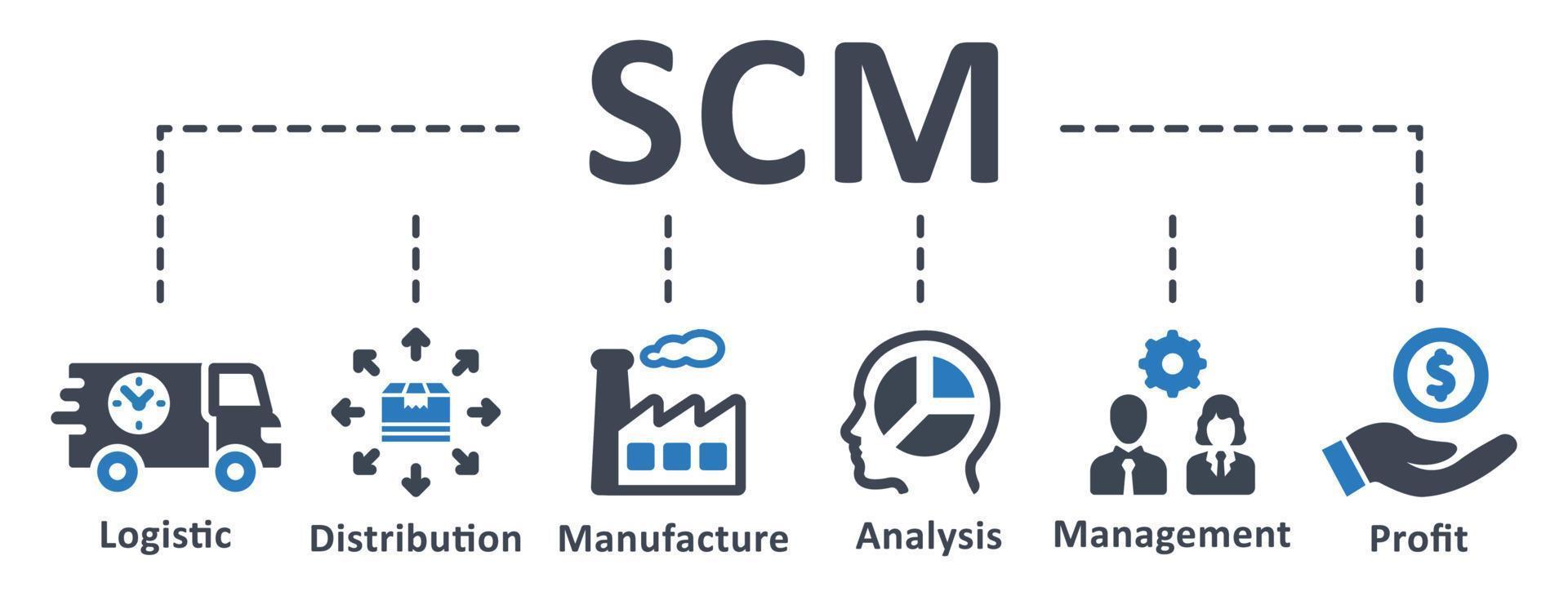
Supply chain management is the process that enables companies to optimize and track the movement of goods and services across all stages of the supply chain, from raw materials to finished products. This management requires a clear vision to ensure things proceed as planned, giving companies the ability to address any disruptions or obstacles that may arise during operations.
Supply chain management involves transforming raw materials into finished goods and delivering them to customers with the highest efficiency and quality. It also focuses on improving processes throughout the supply chain, benefiting both customers and business partners.
Supply chain management involves overseeing a wide network of stakeholders, such as sub-suppliers (e.g., raw material suppliers), suppliers, manufacturers, logistics partners, wholesale distributors, retailers, and end users. The relationships between these stakeholders may be vertical, such as those between parts suppliers, manufacturers, and retailers, or horizontal, where a company collaborates with or acquires other companies.
The role of the supply chain
The supply chain process is an integrated system used by companies to achieve a range of important objectives, such as:
- Source of raw materials: Obtaining the raw materials necessary for the production of goods.
- Manufacturing components: Securing the components necessary for the manufacturing process.
- Assembling finished goods: Assembling goods after they have been manufactured to be ready for distribution.
- Distribution of finished goods: Distribution of finished products through retail outlets or direct-to-consumer sales channels.
- Providing after-sales services: Offering services such as repairs or processing returns to meet customer needs after the purchase process.
A successful supply chain requires coordination between different parties across multiple stages to ensure maximum efficiency and effective results.
What are logistics services?
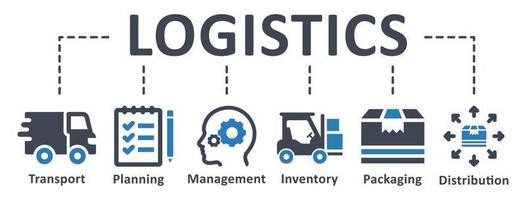
Logistics is the process of planning and executing the efficient flow of goods and services from origin to final destination. These services aim to manage resources in a way that meets customer needs while minimizing costs. Logistics can be divided into three main elements: transportation, warehousing, and inventory management.
Logistics also includes planning and executing the storage and transportation of goods between different points within the supply chain. It also coordinates efforts among facilities, personnel, equipment, and other resources to ensure products are moved on time and have the necessary space at the next station.
The role of logistics
Transportation involves moving goods by land, air, or sea, with products stored in warehouses and inventory tracked to avoid unnecessary costs. Logistics management helps reduce costs, increase efficiency, and improve customer satisfaction through faster delivery, as well as enhancing the ability to track orders and respond to changing market conditions.
- Control and Planning A robust control and planning system is essential to minimizing risks in transportation, distribution, and storage. This includes optimizing safety measures such as temperature control during transport, leading to increased profits through the optimal use of resources.
- Transportation and Storage Transportation and storage operations require careful planning to ensure the efficient movement of goods and information. A sound logistics management system is essential to guarantee timely order delivery and proper product storage.
- Distribution
Logistics distribution includes managing order receipt from online merchants, organizing fulfillment centers, and monitoring inventory to ensure on-time delivery.
What is the role of logistics in supply chain management?
In supply chain management, logistics is responsible for the movement and storage of goods and services, along with the documentation and reports that record those movements throughout the product's journey to the customer.
This element is responsible for determining where goods can be stored at each stage until they are needed at another location, which is essential for effective supply chain management.
Why are logistics services so essential for supply chains?
Logistics is a vital component of supply chains, managing and tracking the people and resources needed to store and transport goods and services. These services ensure that materials and products are moved reliably, on time, and within budget.
Key aspects of logistics services that support supply chains:
- Delivering the right products on time.
- Reduce costs and increase efficiency.
- Enhancing customer retention and increasing their loyalty.
- Providing added value to some companies.
- Providing an efficient means of transporting goods from the most cost-effective production sites to customer sites.
What is the difference between supply chain management and logistics?
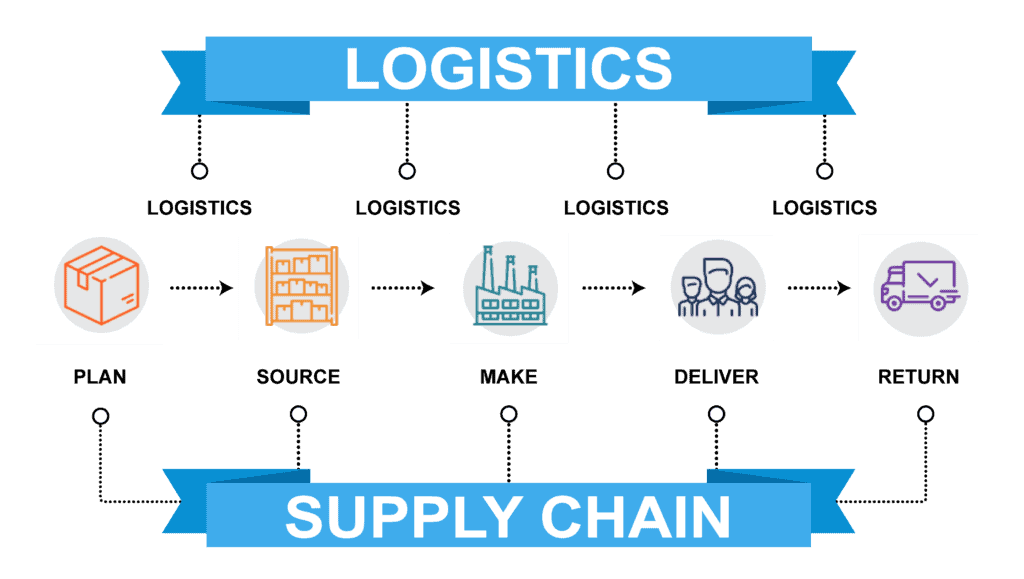
We will review the difference between supply chain management and logistics in the following table:
| Standard | Supply chain management | Logistics services |
|---|---|---|
| Definition | Managing activities from planning, sourcing, production, and distribution | Focus on efficient product transport and storage |
| Range | Comprehensive, covering all stages of the supply chain | Part of the supply chain, focusing on transportation and storage. |
| the goal | Improving processes and creating competitive advantages | Meeting customer needs efficiently and cost-effectively |
| the focus | Production planning, materials management, inventory management, distribution | Delivering goods at the right time and place |
| The intersection | Logistics is included as part of the supply chain. | It focuses on implementing activities within the supply chain. |
| the date | It originated in the twentieth century (the term "supply chain management"). | It originated in the military field and has recently evolved |
Similarities:
- Both focus on the flow of goods and services from the supplier to the consumer.
- Their ultimate goal is to support the company's success and increase customer satisfaction.
Differences:
- Supply chain management encompasses a broader scope that includes production and resources, while logistics focuses on practical aspects such as transportation and storage.
The relationship between production and supply chain management
The relationship between production and supply chain management is characterized by integration and interdependence, and this can be illustrated through the following stages:
- Planning: The production process depends on the availability of raw materials at the right time and place to transform them into finished products.
- Storage: Production processes require a continuous supply of raw materials to ensure smooth workflow, which necessitates effective management of storage and transportation.
- Demand forecasting: Supply chains contribute to demand forecasting by proactively stockpiling raw materials, which helps to organize production lines and balance supply and demand.
- Costs: Supply chain management can reduce production costs by delivering materials on time and streamlining processes.
- Quality control: The production of high-quality products depends mainly on supply chains that must include quality control to ensure that products conform to the required specifications.
- Innovation and technology: Supply chains relying on modern technologies such as artificial intelligence and predictive analytics helps develop production processes, increase efficiency, and foster innovation.
Conclusion
Supply chain management and logistics are vital elements for ensuring efficient operations. Supply chain management focuses on coordinating all stakeholders, while logistics deals with transportation, storage, and distribution. Integrating these two aspects helps companies improve efficiency and reduce costs.